

Roger Federer won eighty percent of his matches. He won only fifty-four percent of the points inside them. Once that gap sank in, I started managing myself differently.
Let me start with a small confession.
A few weeks ago I shipped a documentation article I was proud of. Backup exports, schemas, decryption commands, the works. Three thousand words, every claim checked, the kind of piece I keep telling my team to aim for. Then a colleague ran one section past an AI model, and the model pushed back on something I had written about how data batches get split.
My first reaction was not curiosity. It was a small hot flush of no, I checked that.
Turns out the model had a point. I had gotten a detail wrong. So I went back, traced the data again, and fixed it.
Here is the part worth talking about. The fix took twenty minutes. The sulk almost took the whole afternoon. That gap, between the moment I made the mistake and the moment I actually let it go, is the entire game. Not the mistake. The gap.
I manage a small documentation team. Five writers, a roadmap built around surviving the way AI is rewriting our craft, and the usual run of deadlines, reviews, and decisions that have to happen before I feel ready to make them. Over the last year I noticed something uncomfortable. Almost every time I made a bad call, or froze, or stewed for too long, it traced back to one of five mental hijacks.
Doubt. Rumination. Over-analysis. Catastrophising. And the itch to pick a side before I had actually listened.
What follows is the set of circuit-breakers I now reach for. None of them started with me. I have just dragged each one into the world I actually live in, which is drafts, reviews, appraisal forms, and a Slack channel that never fully goes quiet. Here is the whole map first, then the five protocols one by one.

1. The believable lie
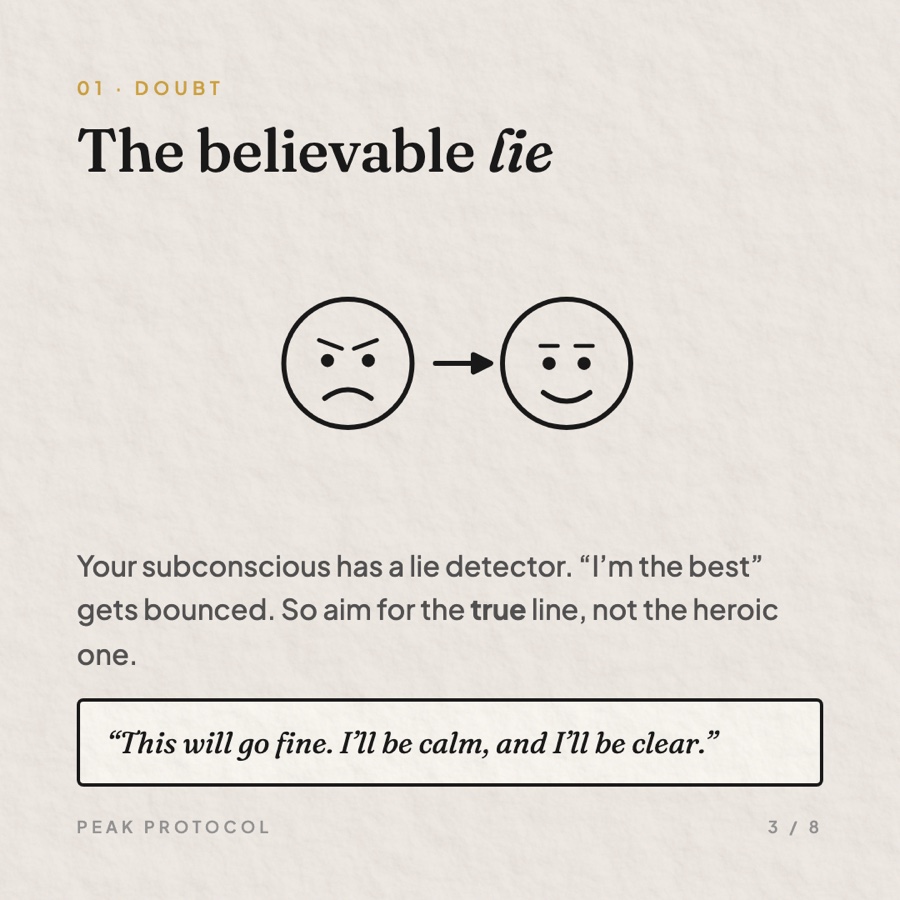
Every appraisal season I have to stand up and make the case for my team. Promotions, headcount, the story of why the work mattered. And every year, in the hour before, the same voice shows up. You haven’t prepared enough. They’ll see straight through you.
For a long time I fought it with pep talks. You’re the best person in this room. It never worked, and now I know why. Some quiet part of me was checking that claim against the evidence, finding it shaky, and throwing it out. Your subconscious has a built-in lie detector, and it is good at its job.
So I stopped lying to it. The line I use now is small and true. This is going to go fine. I’ll be calm, and I’ll be clear. I cannot honestly promise myself I will be brilliant. I can promise myself I will be calm and clear, because I have been both before. The trick is not confidence. The trick is believability.
If your self-talk has to get past your own lie detector, it has to be true. Aim for the plausible line, not the heroic one. “I’ll be calm” clears the gate. “I’m unstoppable” gets bounced.
2. The 54% rule

Back to that documentation article and the AI model that caught my mistake.
Here is what I have learned to do in the seconds after I get something wrong, because I get things wrong all the time, and so will you. I let myself feel it. Five seconds, no suppressing, the small sting of I missed that. Then I name it in one plain sentence. I described the batch split wrong. Then I exhale, sit up, and go back to the work.
That is the whole protocol. Feel it, label it, reset, re-enter. It sounds almost too simple to bother with. But think about what usually happens instead. The mistake plays on a loop. You carry it into the next review and you are half-present. You snap at a writer over a comma because you are still annoyed about something else entirely. The lost point bleeds into the next three.
If you have already pulled the lesson out of a mistake and you are still chewing on it, that is not learning anymore. That is just punishment.
The morning I fixed that article, I caught myself drafting a long mental defense of why my original version was almost right. That is the tell. The lesson was already extracted in minute two. Everything after that was me kicking myself for sport. The 54% rule says stop. Federer does not relitigate the backhand he netted. He walks to the baseline and plays the next one.
3. The first thought
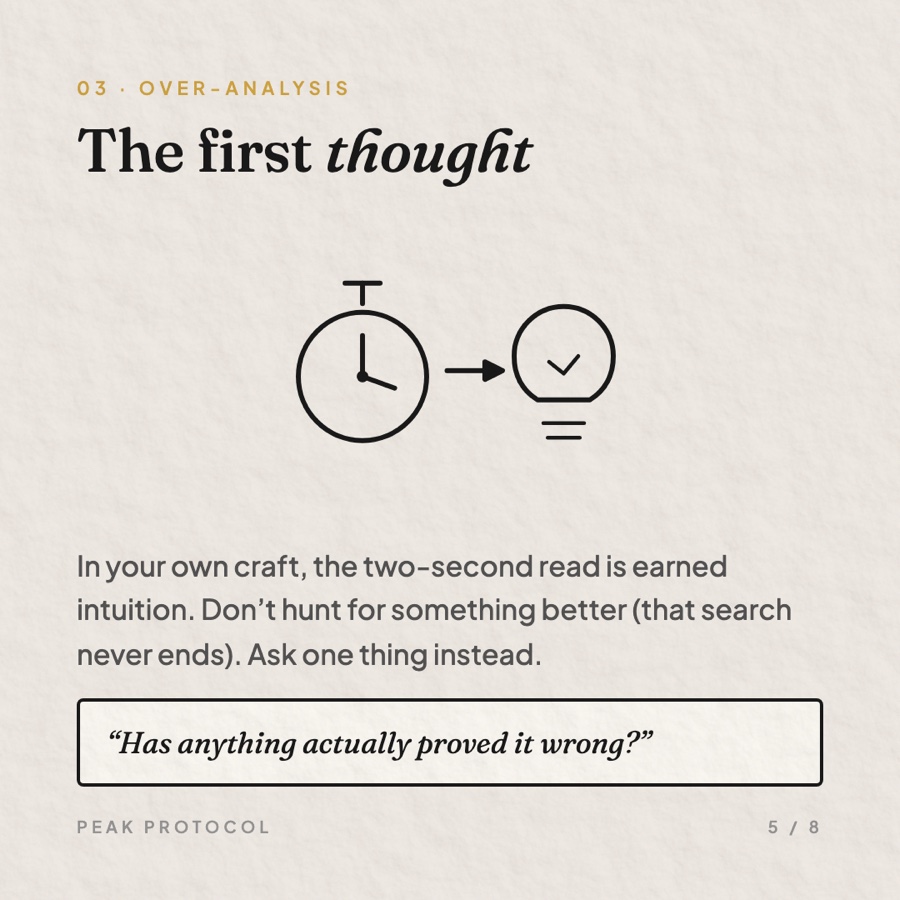
When a draft lands in my queue, I usually know within two minutes whether it works. Not the line edits. The big call. Does this article actually answer the question a reader showed up with, or does it dance around it.
And then, for years, I would spend forty-five minutes talking myself out of that two-minute read. Rereading. Second-guessing. Hunting for a better framing that might be hiding somewhere. By the end I usually landed back where I started, just slower and less sure.
The fix that helped me most is a single question. Not is there something better out there, because that search has no floor and no end. The question is sharper. Has anything I’ve read actually proved my first thought wrong? If nothing has, I ship the first thought. If something has, I follow it. Either way I am out of the maze in minutes.
This one comes with a warning label. First-thought speed only works in places where you have real reps. In my own craft, an instant read is earned intuition. In a domain I barely know, that same instant read is just bias wearing a confident face. No reps, no shortcut. Go find an expert instead.
The reason this works is not mysticism. Your deliberate, talking-out-loud mind is slow and narrow. The pattern-matching underneath it has watched a thousand drafts go by. Under a tight clock, the fast system gets to lead, and in a field you know well, it is usually right.
4. Inconvenience, or problem?
My team spends a lot of time these days staring down a genuinely big question. AI is reshaping technical writing in front of us, and it would be easy to treat every wobble as the beginning of the end. A tool ships that drafts decent docs. A workflow we owned for years gets automated overnight. The first word that arrives, every time, is disaster.
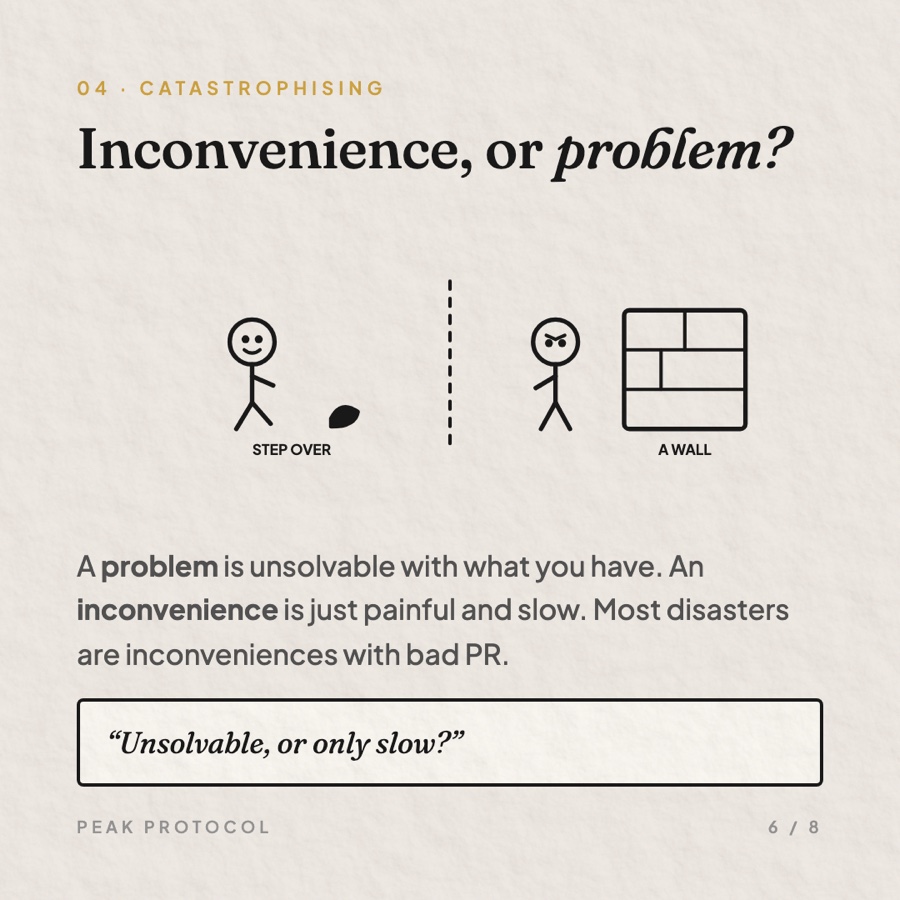
So I drew a line that I now use constantly. A problem is painful and genuinely unsolvable with what I have right now. An inconvenience is painful but solvable with some mix of time, hands, and effort. That is the only difference. And almost everything I had been filing under problem turned out to be an inconvenience wearing a louder coat.
A missed deadline because a build broke the morning of a launch? Painful. Slow. Solvable. Inconvenience. A roadmap that has to be redrawn because the ground moved under our craft? Big, yes. But solvable with planning and a team that can learn. Inconvenience, at the scale of a year.
The label is not denial. It changes what I do next. Call something a disaster and your body braces and your thinking narrows. Call it an inconvenience and your hands start reaching for the fix. Same situation, completely different next five minutes.
5. One more question
This is the one I am worst at, which is probably why I needed a rule for it.
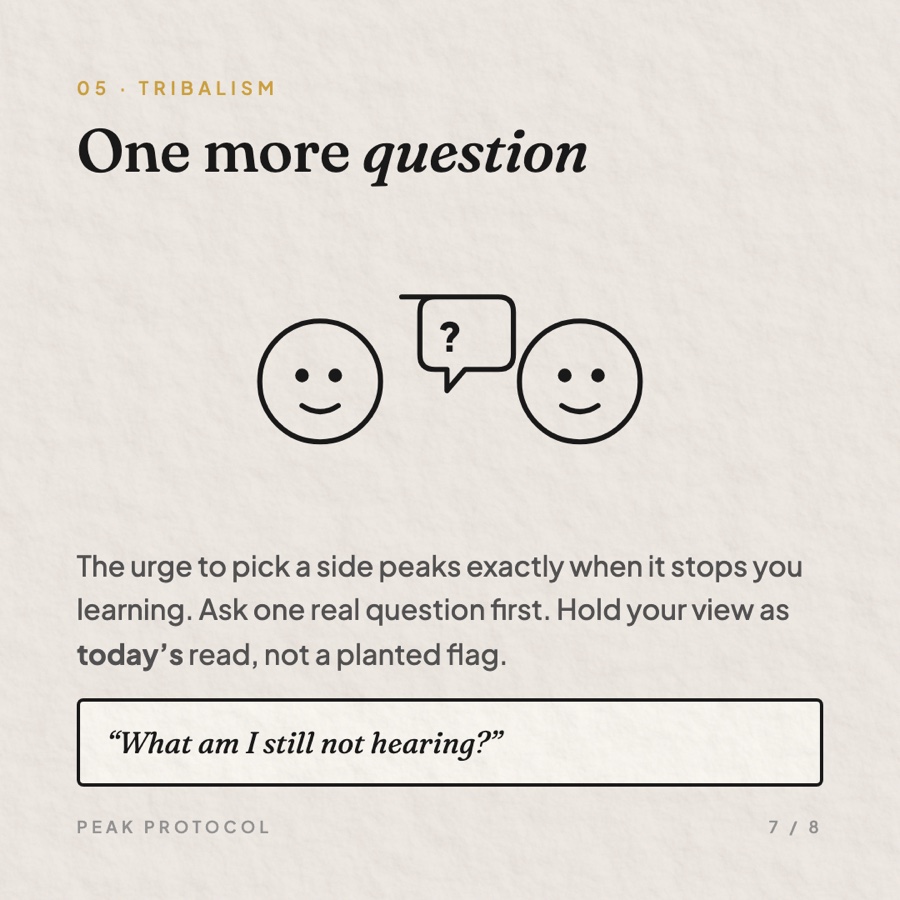
In a debate about how to structure a guide, or whether a feature is ready to document, I feel the pull to plant a flag early. To decide I am the verify-first person and the other writer is the move-fast person, and to argue from there. The trouble is that the urge to pick a side gets strongest at exactly the moment when picking a side stops me from learning anything new.
So I make myself ask one more genuine question before I state my view. Not a rhetorical one dressed up to win. A real one, where I might hear something that changes my mind. And when I do give my opinion, I try to hold it as a position for today, not a flag hammered permanently into the ground.
That last move has a hidden benefit. When you treat your view as today’s best read rather than your identity, conceding to better evidence stops feeling like a loss. It is just an update. The AI model that corrected my article did me a favor, and I could only see it that way because I had stopped defending the old version as mine.
Fifteen minutes on a Sunday
None of this sticks without a quick look back. Once a week, fifteen minutes, I run five questions. Was my self-talk believable this week, or just noise? Which mistake bled into the work that came after it? Where was my first instinct right, and where was it wrong? Where did I call something a disaster when it was only slow? And then the only one that really matters: one thing to do differently next week. Just one.
That last column, the right-and-wrong tally on first instincts, is the quiet engine of the whole thing. It is how the fast read earns more trust over time, or learns to stay humble. Without the audit, the protocols are just nice ideas. With it, they calibrate.
Where this breaks
A fair warning, because I have watched myself misuse all five.
Do not reach for the fast first-thought call outside your real expertise. Do not relabel a genuine problem as an inconvenience just to feel better, because a real problem demands real resources and wishing does not summon them. And when a decision is truly large and hard to undo, do the opposite of everything above. Slow down. Gather what you are missing. Bring in someone who knows more than you. These are tools for the everyday hijacks, the ones that quietly tax a hundred small calls a week. They are not a license to wing the things that deserve your full, patient attention.
But for the rest? For the meeting you are dreading, the mistake replaying in your head, the decision you have somehow been making for an hour, the setback that feels like the sky falling, and the argument you are itching to win?
Name the hijack. Reach for the line. Play the next point.
Adapted from a decision-making framework I keep returning to, retold through a year of running a small writing team and getting plenty of it wrong.